
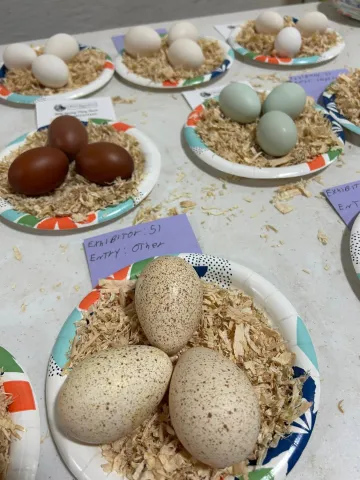
When entering a poultry show or county fair, most people focus on showing their finest birds. But for backyard chicken keepers, egg competitions offer one of the most fun, accessible ways to take home a blue ribbon.
Judging relies on standard poultry scoring criteria—measuring exterior factors like shape, shell texture, and uniformity, along with interior freshness.
1. Pick the Right "Egg Layer" Early
Uniformity is the single most important factor in egg scoring. Because every hen lays eggs with slight variations in shape, size, and pigment, you shouldn't just grab 12 random eggs from the coop.
- Track individual hens: Identify 2 or 3 top-performing layers with smooth, strong shells and consistent coloring.
- Collect over 1–2 weeks: Save daily eggs from your target hen(s) in clean, labeled cartons held in a cool space (ideally around 45–55°F). Having a pool of 20 to 30 eggs makes selecting a matching dozen much easier.
2. Master the Exterior Checklist
Judges grade exterior quality using a strict point deduction system. Examine every egg under bright lighting for the following:
| Evaluation Factor | What Judges Look For | Common Flaws to Avoid |
|---|---|---|
| Uniformity of Shape | Identical length-to-width ratios. | Mixing oval, pointed, or round shapes. |
| Uniformity of Color | Consistent shade across all 12 eggs. | Faded pigments or uneven speckling. |
| Shell Texture | Smooth, thick, and fully calcified. | Ridges, wrinkles, thin spots, or calcium bumps. |
| Cleanliness & Bloom | Clean shell preserving the natural bloom. | Manure, mud, water stains, or a glossy/scoured finish. |
3. Weigh and Match Your Dozen
Size requirements depend on the class you enter (e.g., Large vs. Bantam or standard market weight categories).
- Use a digital kitchen scale to weigh each egg down to the gram.
- Group eggs that weigh almost identically to meet standard minimum weight requirements (a standard Large dozen generally requires ~24 to 27 oz total).
- Avoid mixing lightweight and heavyweight eggs, even if the overall carton weight passes, as inconsistency leads to point deductions.
4. Prepare and Handle with Care
Cleaning and transporting your eggs safely ensures they arrive in show condition:
- Never scrub with water: Washing can strip the protective cuticle (bloom) and leave water streaks. If necessary, use a dry, fine-grit sanding sponge to gently buff away small spots.
- Candle before packing: Hold a flashlight behind each egg in a dark room to check for micro-cracks ("blind checks") or internal air-cell defects that aren't visible to the eye.
- Pack pointed-end down: Always place eggs with the small end pointing down in a clean, sturdy carton. This keeps the air cell stabilized at the top end of the egg.
Final Pro-Tip: Always double-check your event's specific premium book or fair catalog before entry day. Rules can vary on whether judges break eggs open for interior testing, requiring a separate entry process.
Additional resources
- American Poultry Association (APA) - Official Website
- USDA Egg Grading Manual
- University Extension Poultry Show Guidelines
Disclosure: This blog post was generated with the assistance of artificial intelligence (AI) using standard poultry science judging criteria and historical American Poultry Association show guidelines.